
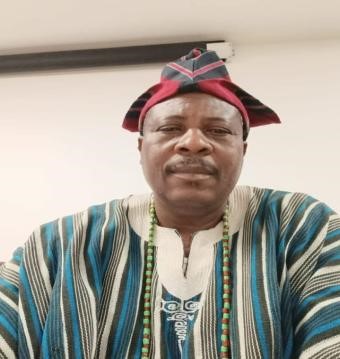
OMIDIRE Felix Ayoh
Email address(es): feliomidire@gmail.com , fomidire@oauife.edu.ng
Office Address: HBI 304A, Faculty of Arts.
Academic Qualifications: PhD
Area of Specialisation – Afrobrazilian Literature
Title of M.A. Thesis – “Une analyse synthétique de la trilogie des “Romans de guerre” de Pepetela à la lumière de la théorie littéraire de Frantz Fanon”
Title of PhD Thesis – ” Yorubanidade mundializada: o reinado da oralitura em textos yorubá-nigerianos e afro-baianos contemporâneos”
Other Publications
Books
(1). Félix Ayoh’OMIDIRE (2000) Olá Amigos: Vamos falar Português, Ibadan: PHINE O
Books. 157pp
(2). Félix Ayoh’OMIDIRE (2004) ÀKÓGBÁDÙN: ABC da lingua, cultura e civilização
iorubanas, Salvador-BA: EDUFBA (University Press, Federal University of Bahia): CEAO (Centro de Estudos Afro-Orientais), 315p.
(3). Mestre Didi, (Deoscóredes Maximiliano dos Santos), Lisa Earl Castillo and Félix
Ayoh’OMIDIRE (2004). Contos crioulos da Bahia; Creole Tales from Bahia; Àkójopò Ìtàn Àtenudénu Ìran Omo Odùduwà ni Ilè Bahia (Brasíì),Tri-lingual edition (Portuguese, English and Yorùbá) organized by Núcleo Cultural Níger Okán, Projeto Cultural e Desenvolvimento Comunitário no Brasil. Salvador: Níger Okán, 232p.
(4). Félix Ayoh’OMIDIRE, (2006). Pèrègún e outras fabulações da minha terra: contos cantados iorubá-africanos, Salvador-BA: EDUFBA/CEAO. 1st Reprint by SeSU/Secad, Brazilian Ministry of Education and Culture (Brasília), August 2006.
(5). Félix Ayoh’OMIDIRE, (2010) Oxente! Viva o português brasileiro. An Intensive
Course in Brazilian Language, Culture and Civilization for Foreigners. Ile-Ife: Obafemi Awolowo University Press. 272p.
(6). Félix Ayoh’OMIDIRE, (2015) Pèrègún y otras fabulaciones de mi tierra. Edición
cubana. Traducción Rodolfo Alpízar. La Habana: Editorial Arte y Literatura.
(7). Félix Ayoh’OMIDIRE, (2016) OXENTE, Viva o português brasileiro!. Nova Edição
Atualizada. Lagos: Fobeh Commercial Enterprises. 279pp
(8). Félix Ayoh’OMIDIRE, (2017). Se correr o bicho pega, se ficar o bicho come: A
Poetics of Becoming in the Waters of the Negro Atlantic. Lagos: Fobeh Commercial
Enterprises. 100pp.
(9). Félix Ayoh’OMIDIRE, (2020). YoruBaianidade: Oralitura e matriz epistêmica nagô
na construção de uma identidade afro-cultural nas Américas. Salvador: Segundo Selo. 505pp.
(10). Félix Ayoh’OMIDIRE, (2020). Ẹ̀kọ́ Dára! Curso Básico de Língua e Cultura Yorùbá I.
Salvador: Segundo Selo/NUPEL.
(11). Félix Ayoh’OMIDIRE, (2021). Ẹ̀kọ́ Dára! Curso Básico de Língua e Cultura Yorùbá 2.
Salvador: Segundo Selo
(12). Félix Ayoh’OMIDIRE, (2022). Ẹ̀kọ́ Dára! Curso de Língua e Cultura Yorùbá 3 (Nível Intermediário). Salvador: Segundo Selo.
(13)Félix Ayoh’OMIDIRE, (2024) ¡Soy Loco Por Ti América! Afro-descendants in Latin America and the Caribbean – Diaspora, Identity, Creativity and Citizenship under the Myth of Racial Democracy. Eine Antrittsvorlessung der Kultur-, Sozial- und Bildungswissenschaftliche Fakultät, Humboldt-Universität zu Berlin. Heraugegeben von der Humboldt-Universität zu Berlin. DOI: 10.18452/28092, Permanent URL: https://doi.org/10.18452/28092. 48 S
Articles
(56). Félix Ayoh’OMIDIRE, (2000) “O outro lado da temática de alienação e
desalienação na poesia africana de expressão portuguesa” IJOFOL, Volume
4, p. 52-66.
(57). Félix Ayoh’OMIDIRE, (2001) “Osun, Haven of Intellectual Pilgrims: A Historical
and Cultural Tour of Osogbo”, NAToG Journal, Volume III, p. 165-176.
(58) Félix Ayoh’OMIDIRE (2001) “Oralité et littérature africaine: une analyse du prologue de F. Oyono à Une vie de boy” in Victor O. Aire and Chris Kuju (eds). «The French Language and Cultures », Proceedings of the Second Annual Conference of the Nigerian University French Teachers Association (NUFTA), Lagos State University, Ojo, Lagos State, pp. 313-328.
(59). Félix Ayoh’OMIDIRE, (2003) “CarnavÁfrica à la Baiana de Acarajé: of the Uses
and Abuses of Africanity in Bahia” (Anales del 8º. Congreso Mundial de la Tradición Yorubá), Edición en CD-ROM, La Habana, Cuba.
(60). Félix Ayoh’OMIDIRE, (2004) “Etnicidade sem visibilidade: um olhar acusador em
torno da música Haiti no disco Noites do Norte (ao vivo) de Caetano Veloso”, Revista Inventário, Journal of the Post-Graduate School of the Instituto de Letras, UFBA, Salvador-BA, Vol. 2. Also available online: http://www.inventario.ufba.br/02.htm. ISSN 1679-1347.
(61). Félix Ayoh’OMIDIRE (2004) “Globalización negociada: tambores parlantes e
hibridaciones culturales” Traducción: Jorge Luis Hernández, Del Caribe, No. 43., Santiago de Cuba, p. 56-59.
(62). Félix Ayoh’OMIDIRE, (2004) “A Edificação do “Yoruba Atlantic Complex”: as
várias representações da identidade iorubana na diáspora”, Sementes – Caderno de pesquisa, Ética da Coexistência, Vol. 5, No. 7, Salvador – BA, Brazil: Universidade do Estado da Bahia (UNEB), Jan/Dez 2004. pp. 55-65.
(63). Félix Ayoh’OMIDIRE, (2006) “Agogo Èèwò ou a reinvenção da nação nigeriana e
seus dirigentes”, AFRO-ÁSIA No. 34 Journal of the Centro de Estudos Afro-Orientais – FFCH/UFBA. Salvador-BA. p.335-345.
(64). Félix Ayoh’OMIDIRE, (2007) “Travesía ideológica de la cuentística nagó-yoruba
en la diáspora brasileña”.Traducción: Ileana de las Mercedes Limonta Hodge.
Revista Del Caribe, No. 50. Santiago de Cuba. p. 10-15.
(65). Félix Ayoh’OMIDIRE, (2010): “Globalization and the Identity Discourse in Latin
America: Caramuru vs the Brazilian Foundation Myth”, THE GLOBAL SOUTH . Volume 4: No. 1. Spring 2010 (Special Issue: Latin America in a Global Age). Indiana University Press. p. 7-30. Also available in Electronic edition at: http://muse.jhu.edu/journals/the_global_south/toc/gbs.4.1.html DOI: 10.1353/gbs.0.0054
(66). Félix Ayoh’OMIDIRE, and Alcione M. Amos (2012): “O babalaô fala: a autobiografia
de Martiniano Eliseu do Bomfim”. Afro-Ásia No.46. Journal of the Centro de Estudos Afro-Orientais – CEAO/UFBA. Edited by João José Reis and Florentina da Silva Souza. Pg. 229 – 261. Available online at www.afroasia.ufba.br. ISBN:1981-1411
(67). Félix Ayoh’OMIDIRE. (2012): “A lei federal 10.639/03: Caminhos de Zumbi,
sonhos da liberdade e igualdade étnicorraciais no Brasil do Novo Milênio”. Ife Journal of Foreign Languages (IJOFOL), Special Edition to mark the 50th Anniversary of the Obafemi Awolowo University. No. 8. Volume Editors: Babatunde Ayeleru and Ajoke Mimiko Bestman. Pp. 269-279.
(68). Félix Ayoh’OMIDIRE. (2014): “Fome Zero for Ethnic Marginalization?: Reconceptualization of Empowerment in Contemporary Afro-Brazilian Popular Culture”. Unidad Sociológica , Publicación cuatrimestral. Universidad de Buenos Aires, Argentina. Año 1, N° 1. Mayo-Septiembre 2014. Pg. 16-27. Available online at http://www.unidadsociologica.com.ar/. ISSN 2362-1850.
(69). Félix Ayoh’OMIDIRE. (2015): “Favelas, Fome Zero and State Welfarism or the Quest for Racial Equality and Empowerment in Contemporary Brazil”. EUREKA: A Journal of Humanistic Studies (Special Russian Edition), University of Lagos. Vol. 4 :2, April 2015. Pp. 54-77.
(70). Félix Ayoh’OMIDIRE. (2015): “Mestre Didi: Nago Tales and the Re-Invention of Literary Genres in Afro-Brazilian Literature”. Ibadan Journal of European Studies. No. 14, 15 & 16. ISSN 1595 -0344. Pp. 238-265.
(71). Félix Ayoh’OMIDIRE. (2016): “Flux et Reflux Revisited: Aguda Cosmopolitanism and the Re-Invention of an Afro-Brazilian Creole Identity in the Bight of Benin”. SAUT Multi-Disciplinary Journal of Education, St. Augustine University of Tanzania. Mwanza, Tanzania. Vol. 1 (1), May 2016. Pp. 87-102.
(72). Félix Ayoh’OMIDIRE. (2018): “Ifayemi Elebuibon e a gnose nagô-yorubana: A poesia cantada na busca pelo descolonização do saber no mundo globalizado”. Fólio – Revista de Letras. [S.I]. Vol. 10, Número 2, Pág. 113 – 134. ISSN. 2176-4182. Disponível em http://periodicos2.uesb.br/index.php/folio/article/view/4709.
DOI: https://doi.org/10.22481/folio.v2i10.4709
(73) Félix Ayoh’OMIDIRE. (2019): “Òrò leye ngbo! A Deserving Tribute to Alagba Adebayo Mosobalaje Ajibade Akande Faleti (Ode Àdàbà). Yoruba Studies Review. Volume 3, Edited by Pamela O. Smith. Florida. Nunber 2, Spring 2019. University of Florida, USA, pages 33-37. ISSN 2473-4713.
(74). Félix Ayoh’OMIDIRE. (2021): “ADN – Abdias do Nascimento – Odyssey of an Afro-
Brazilian Organic Intellectual of the 21st Century”. IFÈ: Journal of the Institute of Cultural Studies (IJICS), Volume 14 (Special Issue OAU@60). Pp. 16 – 42.
(75). Félix Ayoh’OMIDIRE. (2022): “Ojú woni bíi kákú, òrìṣà ni kò gbóhùn aṣìkà! –
Homenagem a Ọlábíyi Babalọlá Yai (1939 – 2020). Afro-Ásia No. 65, Revista do CEAO-UFBA, pp. 649-670.
(76). Félix Ayoh’OMIDIRE (2023). “A África, a Nigéria, os Iorubás> diálogos com o Brasil,
ontem e hoje”, in Boletim GeoÁfrica. vol. 2. no. 6. abr. – jun. 2023. Universidade Federal de Rio de Janeiro (UFRJ). pg. 97 – 105. DOI: 10.59508/geoafrica.v2i6.59841. Also available online at: https://revistas.ufrj.br/index.php/bg/issue/view/2586/showToc
(77). Elizabeth Cardoso and Félix Ayoh’OMIDIRE (2025). “Literatura de ancestralidade
negra: encruzilhadas diaspóricas / Black Ancestral Literature: Diasporic Crossroads”. Bakhtiniana: Revista de Estudos do Discurso. LAEL/PUC-SP (Programa de Estudos Pós-Graduados em Linguística Aplicada e Estudos da Linguagem da Pontifícia Universidade Católica de São Paulo). Volume 20, Issue 3. Pp. 1-11. ISSN online version: 2176-4573. D.O.I. http://dx.doi.org/10.1590/2176-4573p72489.
(c). Manuscripts Accepted for Publication:
(78). Félix Ayoh’OMIDIRE, Adeniyi KOFOWOROLA and Anike R. OMIDIRE. “Intercâmbio Educacional e o Diálogo Sul-Sul;. A OAU-IFÉ no pioneirismo, protagonismo e eficiência da aplicação do Exame Celpe-Bras no Continente africano. Accepted for publication in Lise Mary Arruda Dourado…. Salvador: UNEB.
(79). Decolonizing Knowledge: Lei 10.639/03 or the Ascension of Afro-Brazilian Epistemology within the Brazilian Educational System. in AJALA, Suleyman Aderemi. Decoloninising Education… Humboldt Kolleg Publication. University of Ibadan. 2020.
(80). “Dez obras para conhecer línguas africanas”, in CARVALHO Danniel GuiaLET – Guia de Leituras do Instituto de Letras, Universidade Federal da Bahia. Volume 2 – Línguas e Literaturas. Salvador: EDUFBA. 2021 (In Press)
(81). “YoruBantu – uma práxis epistémica para os valores pan-africanas em estudos afro-brasileiros” in FREITAS, Henrique (ed). Yorubantu, epistemologias yoruba e bantu na análise detextos da literatura e cultura afro-brasileira.
(82). “Afro-Identity and the Decolonization of Praxis: A Journey of Consuming and Producing Textbooks for the Teaching of Portuguese in Nigeria” in ANTIA, Bassey (Ed.) Decolonizing the Textbook for the Teaching of Foreign Languages in African Universities”. Cape Town: University of Cape Town Press.
(f). Book Review
(83). Book Review. Florentina SOUZA, Maria Nazaré LIMA (eds.). Literatura Afro-Brasileira. Salvador: Centro deEstudos Afro-Orientais / Brasília: Fundação Cultural Palmares. 2006. 216 pages + illustrations. Reviewed in Omoteso, E.A. (ed.) Ife Journal of Foreign Languages (IJOFOL). No. 6. June, 2007. pg. 202-204.
(84). Book Review. “Covering the Proverbial Distance Faster and Safer” a review of Aderemi Raji-Oyelade’s Playful Blasphemies, Postproverbials as Archetypes of Modernity in Yorùbá Culture. Trier: WVT Wissenschaftlicher Verlag. (Studien zu Literaturen und Kunst Afrikas; Bd. 3). 2012. In Matatu: Journal for African Culture and Society. Volume 47. (Landlines in African Literary Studies. Edited by Gordon Collier. Leiden | Boston. 2015. Pg. 341-346.
(85). Book Review (Resenha): Rowland Abiodun. Yoruba Art and Language: Seeking the African in African Arts. New York: Cambridge University Press; 2014. In IFÈ: Journal of the Institute of Cultural Studies (IJICS). Vol 13. Pg. 261-268.
(86). Book Review: Flora Veit-Wild, They Called You Dambuzdo (Memoir). 2020. Auckland Park: Jacana Media. In IFÈ: Journal of the Institute of Cultural Studies (IJICS). Vol 14. Pg. 281 – 283.